
 Product 7.2
 System able to record motion of invertebrates adult organisms as indicator of pollution stress and toxicity in the aquatic environment
An artificial intelligence (AI)-based technology designed to automate the monitoring of behavioural responses in marine invertebrates was developed. By reducing manual analysis and bias, an AI-system may significantly accelerate the monitoring process while improving measurement consistency. Thus, the proposed system integrates computer vision and machine learning techniques to detect, analyze, and quantify behavioural patterns in a fast, objective, and operator- independent manner.
Manual counting and analysis of behavioural responses were also performed, allowing for comparison between traditional and AI-driven methods in terms of accuracy, efficiency, and reliability. With this aim, we analysed the behavioural response – in terms of valves opening/closing – of an adult crustacean, the marine barnacle Amphibalanus amphitrite. This species was selected for its wide distribution area (exposed and sheltered rocky shorelines, boulders, mangrove trunks, jetties and even floating marine debris), its abundance, sessility and ease of sampling. Due to its high tolerance to environmental stress, it is commonly used in pollution monitoring, such as heavy metals and polybrominated diphenyl ethers in coastal waters.
Experimental and recording setup
Two experimental set-ups were adopted, one for laboratory trials and a second for field testing (Figure 2). During the experiments the influence of temperature, a basic environmental parameter, organisms’ behavioural response was investigated. For laboratory trials, two different temperatures (15°C, 20°C) were set , while field testing was carried out at the Experimental Marine Station (EMS) (44°23’44.6” N; 8°55’53.2” E) of the National Research Council (CNR) located in Genoa harbour (Ligurian Sea, Western Mediterranean) by diving organisms at a depth of -2 meters during different seasons (autumn and winter), with a seawater mean temperature of 20°C and 15°C respectively. As regards laboratory trials, to simulate real scenarios, several environmental triggers (microalgae as food supply and the presence of suspended organic matter) were used, to detect their potential influence on valves opening/closure. Both for laboratory and field trials, sixteen organisms – previously acclimated – were placed in a grid (4×4), as reported in figure 1 and then 4 sequential videos of 5’ each one (named video 1, video 2, video 3 and video 4) were recorded. The grid arrangement, with specimens very close each other, was chosen to reproduce the species ecology in natural environments.
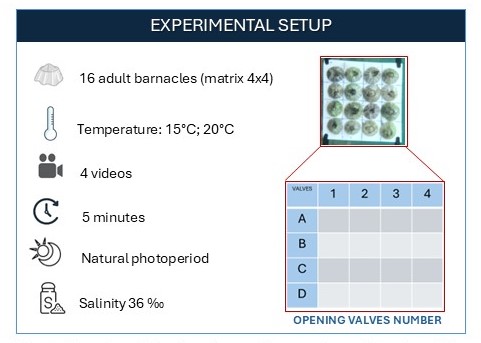
Figure 1. Experimental setup to monitor opening valves in adult barnacles.
The laboratory recording setup was carried out using an IR camera at dark (Figure 2a) while in field an Action Cam was used (Figure 2b).
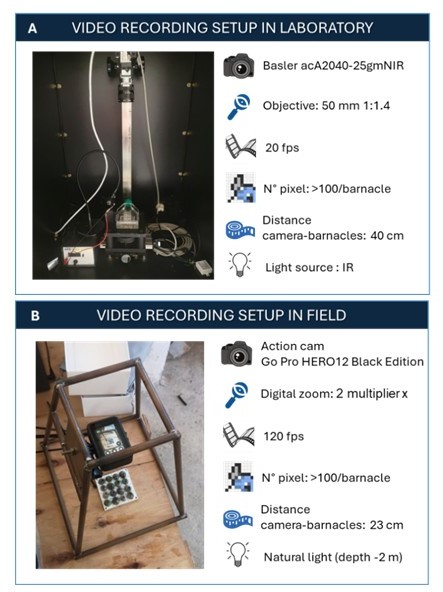
Figure 2. Video recording setup in laboratory (a) and in field (b) to monitor opening valves in adult barnacles.
After recording, for each video, the percentage of active organisms – defined as barnacles showing opening/closure of valves at least once during the 5’ recording – was calculated. In addition, the frequency of opening/closing valves was manually detected using a cell counter for each 5’ videos and then compared to the automatic AI-based count.
AI-based methodology
To detect and analyze the opening and closing frequency of barnacle, an intelligent monitoring system was developed, capable of detecting each barnacle in a scene and to analyze valves movements (opening/closure) of each organism detected. The intelligent monitoring system consists of the following components:
- Barnacle Detector: The system uses a barnacle detector developed by fine-tuning YOLOv11 from Ultralytics on a custom barnacle dataset.
- Valves State Classifier: Once the barnacles are detected, the intelligent monitoring system determines whether the valves are open or closed in each frame thanks to a binary classifier, developed from scratch using a custom Convolutional Neural Network (CNN) implemented in PyTorch.
- Data Processing Module: After classification, all data collected by the detector and classifier are processed to count the valves movements for each barnacle.
The results obtained with AI-based technology to identify active organisms percentage and opening valves frequency were compared with those manually observed and detected.
AI-validation in laboratory
Figure 3 shows the percentage of active organisms recorded in the laboratory at two temperatures (15°C and 20°C), under two different conditions: with a trophic source (A) and with suspended organic matter (B). Four 5-minute videos were analyzed for each temperature. The graphs display results obtained through both the AI-based system and manual counting. A high proportion of active organisms (>50%) was observed, indicating that most barnacles displayed at least one valve movement during the 5-minute recording period (Figure 3). The highest activity levels (>60%) occurred in the presence of a trophic source (microalgae), regardless of temperature (Figure 3a), suggesting a stimulating effect of food availability. Conversely, when suspended organic matter was present, barnacle activity was lower compared to trials with microalgae. Regarding the validation of the AI-based approach, AI and manual detections produced comparable percentages of active organisms in each 4×4 barnacle matrix tested, irrespective of temperature or environmental conditions (Figure 3).
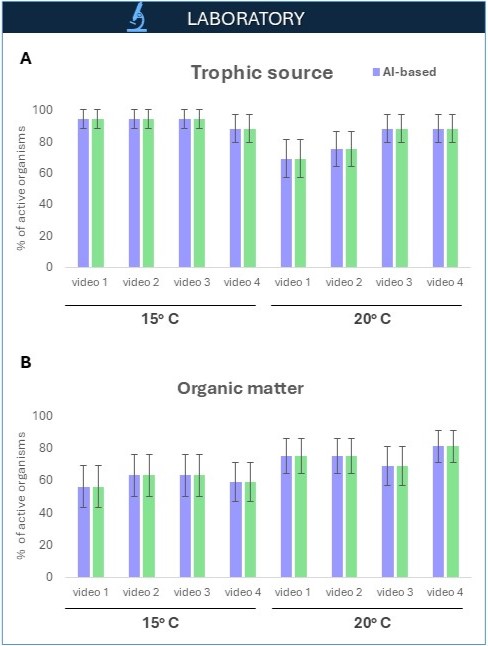
Figure 3. Laboratory trials: percentage (%) of active organisms detected through AI-based approach (violet bars) and manually (green bars) in adult barnacles in presence of microalgal trophic source (a) and suspended organic matter (b) at the two temperatures (15°C, 20°C).
AI-validation in field
Figure 4b shows the percentage of active organisms recorded with the field trials set-up during the winter and fall seasons, corresponding to mean seawater temperatures of 15°C and 20°C, respectively. As reported for the laboratory AI- validation, four sequential videos (5’ each one) were analyzed for each temperature. The graphs report both the results obtained with the AI-based system and those from manual counting. It can be observed that in the outdoor trials, less than 50% of the organism showed activity at both temperatures. These results appear in contrast with those observed in the laboratory trials, where barnacles exhibited high percentages (>60%) of activity (Figure 3). In terms of validating the AI-based approach, both AI and manual detection show comparable activity percentages across each matrix (4×4) of barnacles used in the different tests, regardless of temperature (Figure 4b).
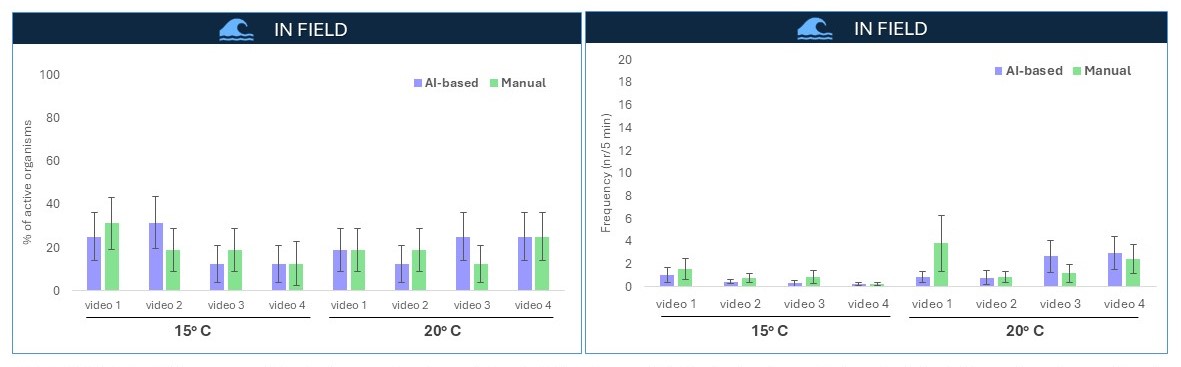
Figure 4. Field trials: a) percentage (%) of active organisms detected through AI- based approach (violet bars) and manually (green bars) in adult barnacles at the two selected temperatures (15°C, 20°C); b) frequency (nr/5 minutes) of valves opening detected through AI-based approach (violet bars) and manually (green bars) in adult barnacles at the two selected temperatures (15°C, 20°C).
Figure 4a shows the frequency (number per 5 minutes) of valve opening and closing recorded in the field during two seasons, when the average seawater temperatures in the Eastern Mediterranean Sea (EMS) were 15°C and 20°C. Outdoor experiments recorded few valve movements: fewer than 5 events per 5-minute video at 15°C and fewer than 10 at 20°C. As observed in previous analyses, AI-based and manual detections yielded comparable frequencies for each 4×4 barnacle matrix, further confirming the validity of the AI system under outdoor conditions (Figure 4b). The frequency values obtained using the AI-based detection method closely matched those from manual counting, supporting the reliability and potential of the automated approach for behavioral monitoring. Statistical analysis using the Wilcoxon signed-rank test showed that the null hypothesis — that the observed frequency differences have a median of zero — could not be rejected (p = 0.55), indicating no bias between the two estimates. Furthermore, the Spearman correlation was highly significant (ρ = 0.79, p = 0.025), confirming a strong monotonic relationship between the AI and manual measurements. Laboratory trials showed a higher percentage of active organisms compared to field experiments, especially when a food source was added, suggesting that food availability stimulates barnacle activity within the tested temperature range (15°C–20°C). Unlike traditional manual or sensor-based observation methods, AI-based technologies are emerging as powerful tools for assessing marine health and detecting anthropogenic impacts — for example, in marine litter detection, reef fish population studies, and sea ice monitoring. However, prior to this study, no AI-based systems had been reported for analyzing valve-opening behavior in adult A. amphitrite. The developed automatic detection system uses an infrared camera for indoor trials and an RGB camera for outdoor trials to capture images of barnacle movements. These images are processed by state-identification software and a data counter. Results showed a strong correlation between AI-generated data and manual observations, confirming the reliability and effectiveness of the AI-based system. This approach significantly reduces the need for time-consuming manual analysis, enables high-throughput and non-invasive ecological monitoring, and opens new perspectives for studying other marine species under various environmental conditions.