
 Product 9.4
 Design tool for geothermal storage
The Product 9.4 “Design tool for geothermal storage” essentially consists of a literature analysis on design methods of borehole heat exchangers for geothermal heat pumps and geothermal storage applications, with the related recent developments aimed at covering the possibility of involving solar thermal energy. Among these developments, the Geothermal Heat Pump Portal and Online BHEDesigner8 by Unige/Dime (https://en.geosensingdesign.org/) have been successfully employed to compare the modified ASHRAE-Tp8 method by Unige with already existing commercial codes (EED, GLHEPRO) for the correct design of ground heat exchangers at a 10-year time horizon. The use of the online portal allows smart, accurate, and reliable design of BHE fields. An updated version of the modified ASHRAE-Tp8 method by Unige has been realized by calculating new optimized constants suitably tuned to reference solutions for the correct design of ground heat exchangers at a 25-year time horizon, which is commonly targeted by any energy facility. All calculations using the BHEDesigner8 were performed directly through the web application developed by the authors and were compared to results obtained from the EED software. The case studies included in this analysis span a diverse range of BHE lengths, depths, and field configurations, representing installations from around the world. The average increase in the overall borehole length between the 10th and 25th year is 14 %.
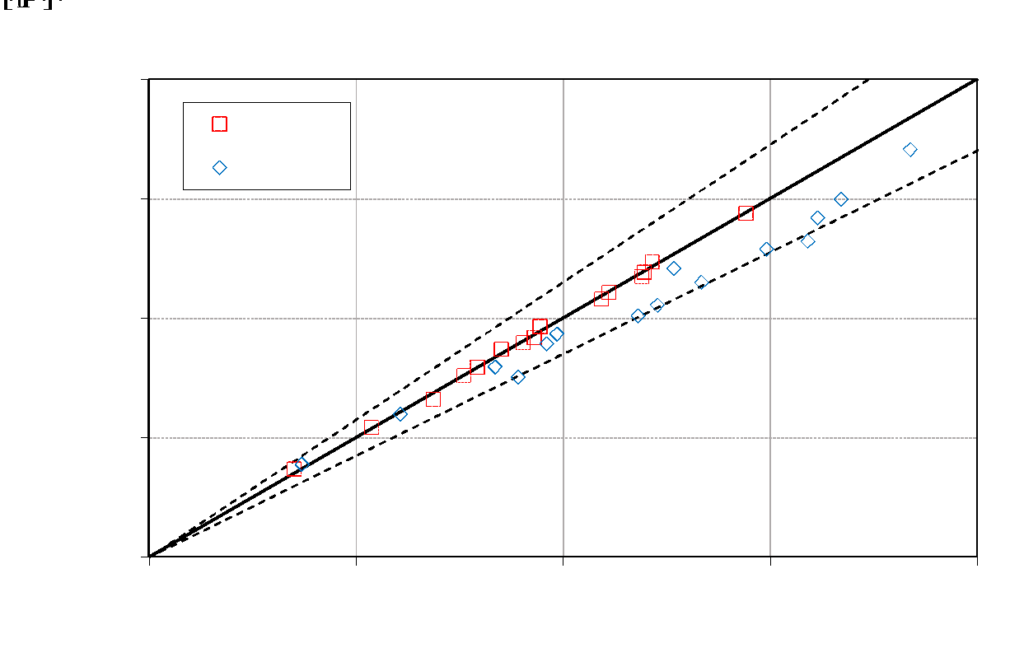
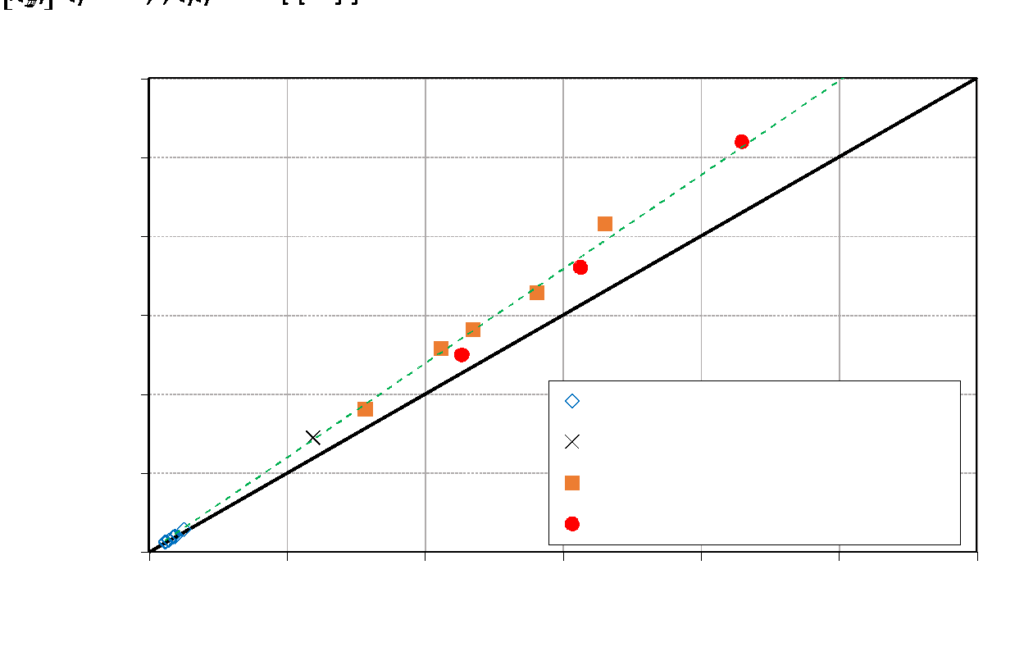
As shown by Figures 1 and 2, this study presents a comprehensive comparison between the newly proposed ASHRAE-Tp825 method, developed for a 25-year design horizon, and the conventional ASHRAE-Tp810 method, which corresponds to the standard 10-year design horizon widely adopted in the design of GCHP systems. Both methods have also been benchmarked against commercial reference software (REF) for their respective time horizons (10 and 25 years), allowing for an in-depth evaluation of accuracy and applicability. The accuracy and robustness of the proposed enhanced method have been thoroughly validated, showing an average deviation of only 3.8% compared to the reference code over a 25-year operational horizon. The results highlight the potential inaccuracies in estimating the total borefield length and individual borehole depth when the conventional 10-year design approach is considered applicable to cover a 25-year timeframe. Conversely, this study also demonstrates that properly accounting for long-term performance may require increased borehole depth, leading to higher drilling costs, with the total borefield length potentially increasing by up to 16.8%.
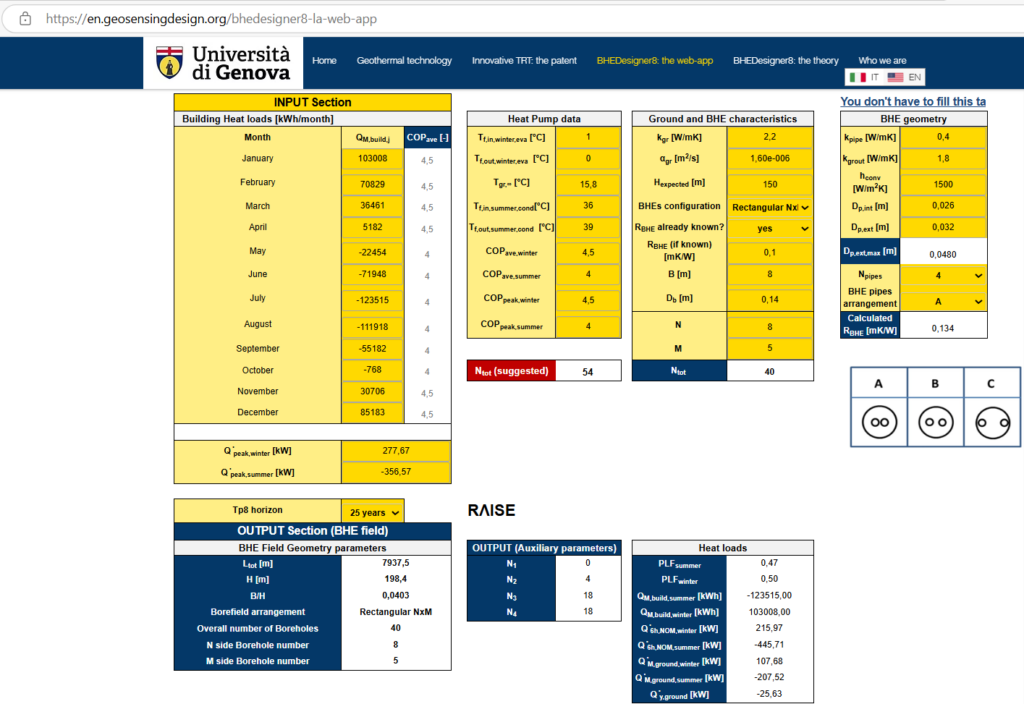
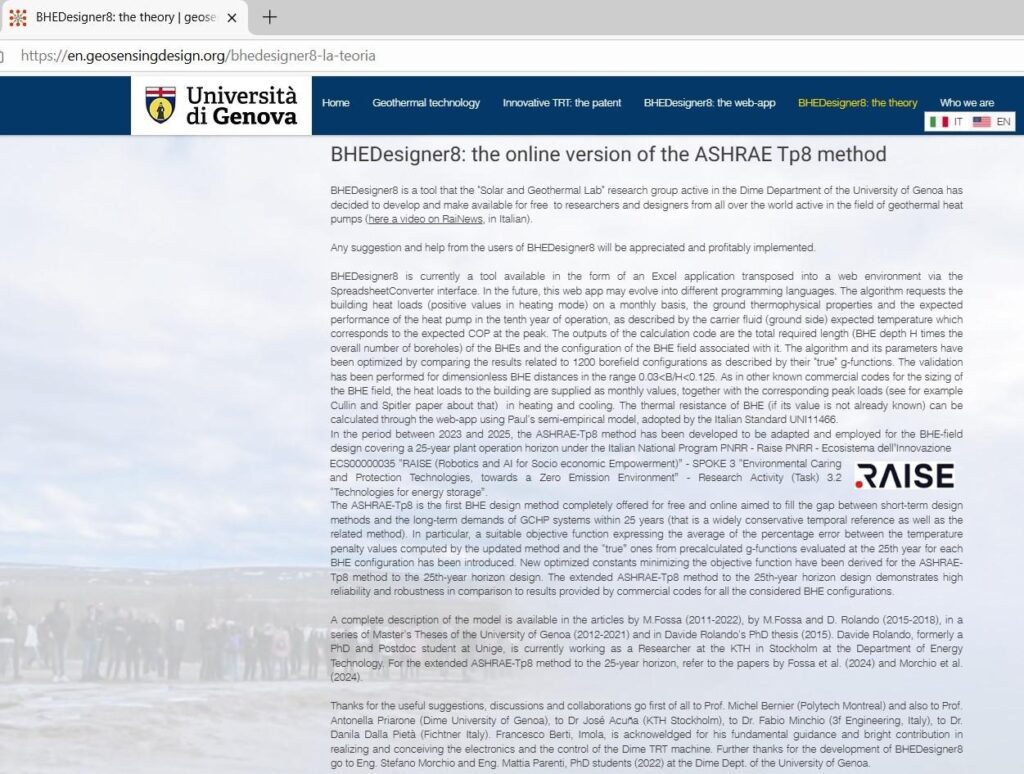
The updated method has been embedded in the public web application named BHEDesigner8, accessible online for free at https://en.geosensingdesign.org/bhedesigner8-la-web-app. The web portal acknowledges the RAISE contribution to its further development. The BHEDesigner8 is the first worldwide Online Designer for Ground Heat Exchanger Fields accessible for free. Figure 3 aims to report the updated version of the BHEDesigner8 web application provided by the present Product 9.4, incorporating the important features related to the 25-year horizon design. Particular attention has to be given to the new important feature related to the possibility of selecting the 10-year or 25-year horizon design. These designs, resulting from an iterative method able to reach fast convergence after a few cycles, are done in real-time automatically by the BHEDesigner8 without any computation waiting time for the user. In addition, it is important to highlight that among the work behind the present Product 9.4, the website https://en.geosensingdesign.org/ has been updated with a summary of the activity carried out in the period between 2023 and 2025, as shown in Figure 4. New models for analysis of borehole heat exchangers for geothermal heat pump applications have been developed to support the calculation tool. Modeling involves single-phase storage systems with considerations regarding the quality of the energy stored within the storage and the system costs and avoided emissions. To complement the above aspects, new analysis and experimental activity are devoted to performance prediction and diagnostics of PV fields using bifacial modules, both fixed-position and single-axis tracking. The field research activity has been pursued at the DIME-Unige and Savona campus, where the Solar and Geothermal Lab makes use of a geothermal system serving an entire building and a constituent single-axis tracking bifacial solar system, as reported by Figures 5 to 7.
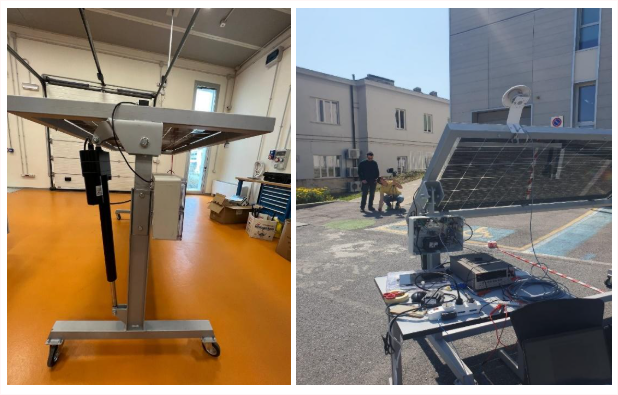
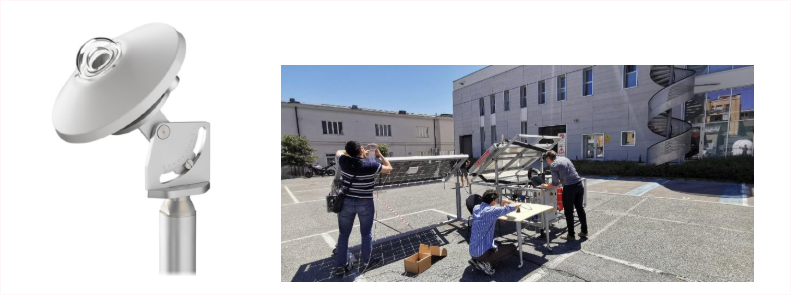
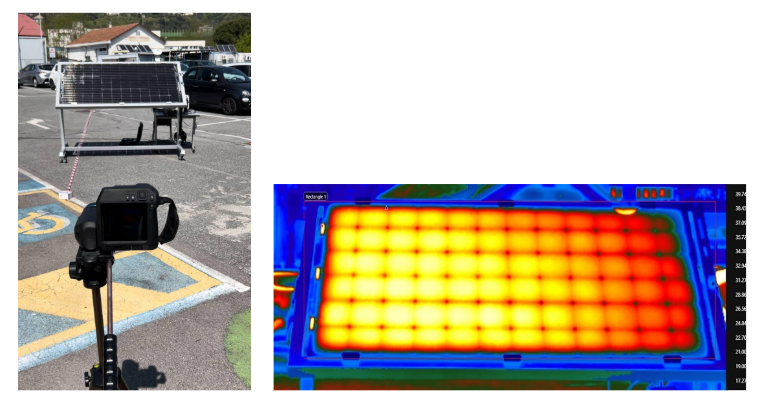
In this context, the Journal and Conference papers reported in the References list have been published.
References
Fossa, M., Morchio, S., Priarone, A., Memme, S. Accurate design of BHE fields for geothermal heat pump systems: the ASHRAE-Tp8 method compared to non aggregated schemes applied to different European test cases, Energy and Buildings (IF 6.7), 2023, 113814, ISSN 0378-7788, https://doi.org/10.1016/j.enbuild.2023.113814
Priarone A., Morchio S., Fossa M., Memme S. (2023). Low-Cost Distributed Thermal Response Test for the Estimation of Thermal Ground and Grout Conductivities in Geothermal Heat Pump Applications. ENERGIES, vol. 16, p. 1-16, ISSN: 1996-1073, https://doi.org/10.3390/en16217393
Priarone A., Fossa M., Morchio S., Silenzi, F. (2024). Energy demand parametric analysis and geothermal heat exchanger design applied to a nearly zero energy PV building in northern Italy. ENERGY AND BUILDINGS, vol. 316, p. 1-15, ISSN: 0378-7788, https://doi.org/10.1016/j.enbuild.2024.114292
Fossa, M., Morchio, S., Memme, S., Priarone, A., Parenti, M. Extending the ASHRAE method to a 25 year horizon through the Tp8 model for temperature penalty accurate estimation, International Ground Source Heat Pump Association IGSHPA Research Conference, Montréal, May 28-30, 2024, https://hdl.handle.net/20.500.14446/344452
Morchio, S., Fossa, M., Priarone, A., Memme, S. Extended version at 25 years of the ASHRAE-Tp8 method for the design of BHE fields operating with geothermal heat pumps, Geothermics, Volume 123, 2024, 103128, ISSN 0375-6505, https://doi.org/10.1016/j.geothermics.2024.103128
Morchio, S., Fossa, M., Memme, S., Parenti, M., Priarone, A. Comparison of 10- and 25-year horizon designs for vertical borehole heat exchangers in geothermal heat pump applications, Geothermics, Volume 132, 2025, 103457, ISSN 0375-6505, https://doi.org/10.1016/j.geothermics.2025.103457
Morchio, S., Fossa, M., Memme, S., Priarone, A. (2025). A free online tool for the design of borehole heat exchanger fields in geothermal heat pump applications at 10 and 25-year horizons. Mathematical Modelling of Engineering Problems, Vol. 12, No. 11, pp. 3980-3988. https://doi.org/10.18280/mmep.121124
Morchio, S., Beier, R.A., Modelling the U-pipe heat exchanger to estimate the borehole thermal resistances from distributed thermal response test data, Geothermics, Volume 132, 2025, 103408, ISSN 0375-6505, https://doi.org/10.1016/j.geothermics.2025.103408
Sadeghi, R., Parenti, M., Memme, S., Fossa, M., Morchio, S. A Review and Comparative Analysis of Solar Tracking Systems. Energies 2025, 18, 2553. https://doi.org/10.3390/en18102553