 Product 9.3
 Superconductive sensor for measuring the level of liquid hydrogen stored in tanks
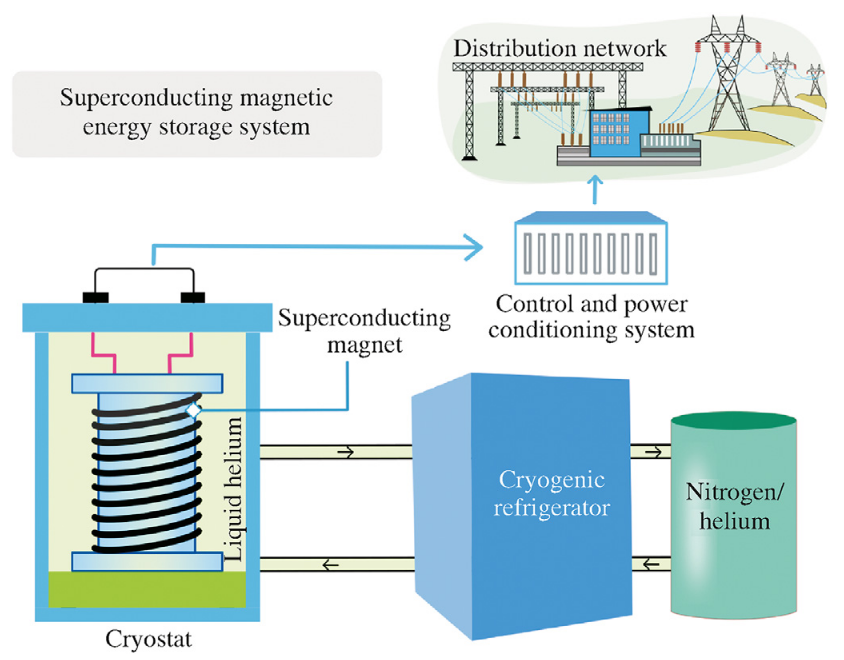
A worldwide uptick in enthusiasm for power generation from renewable sources has focused a new spotlight on energy storage technology. A superconducting magnetic energy system (SMES) is a promising new technology and more environmental friendly alternative to the more common chemical, battery-driven storage.
SMES technology uses a superconducting coil to convert electrical energy into a magnetic form for storage.
SMES efficiency increases as the magnetic field of the coil increases:
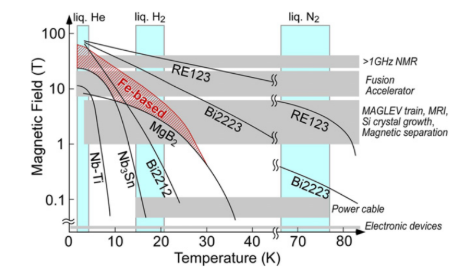
Goal: find a superconductor that can work at LH temperature and high fields.
SMES systems have been developed – based on liquid-He cooled superconductors – and successfully submitted to live grid installation. Significant improvements could be obtained through innovative superconductors with higher Tc compatible with cryogen free cooling. Furthermore, the possible integration with the use of H – used as coolant for SMES – represents one of the advanced technologies for solving energy and environmental problems.
We focused on Fe-based superconductors which have high potential in the magnetic field range useful for SMES, i.e. between 5 and 10 T.
We validated of two technologies to fabricate two phases of Fe-based superconductors:
- the Fe(Se,Te) family through the Pulsed Laser Ablation
- the BaFe2As2 family by means of the Powder-In-Tube
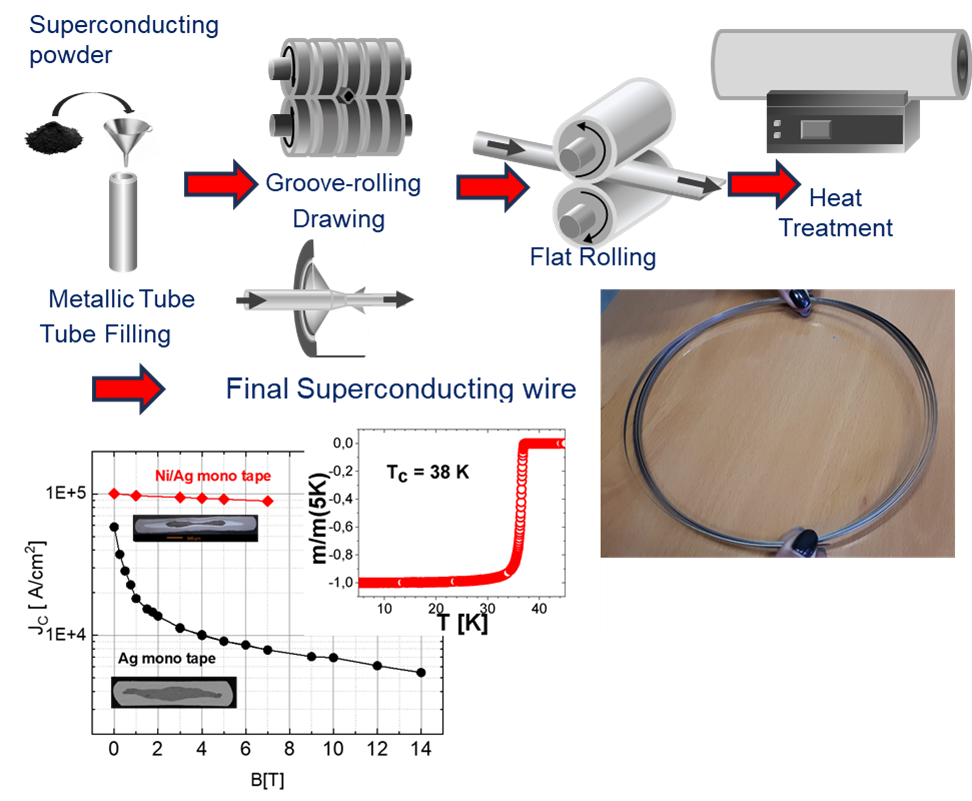
Powder-In-Tube process – (Ba,K)Fe2As2 Wires and Tapes
We optimized fabrication process, heat treatment and sheath, and increased Jc of almost one order of magnitude in the range 5-10 T.
The critical temperature Tc is 38 K => the use at Tc/2 ≈ LH temperature is possible.
Pulsed Laser Ablation – Fe(Se,Te) Thin Films and Coated Conductors
We optimized fabrication process of films and simple Coated Conductors.
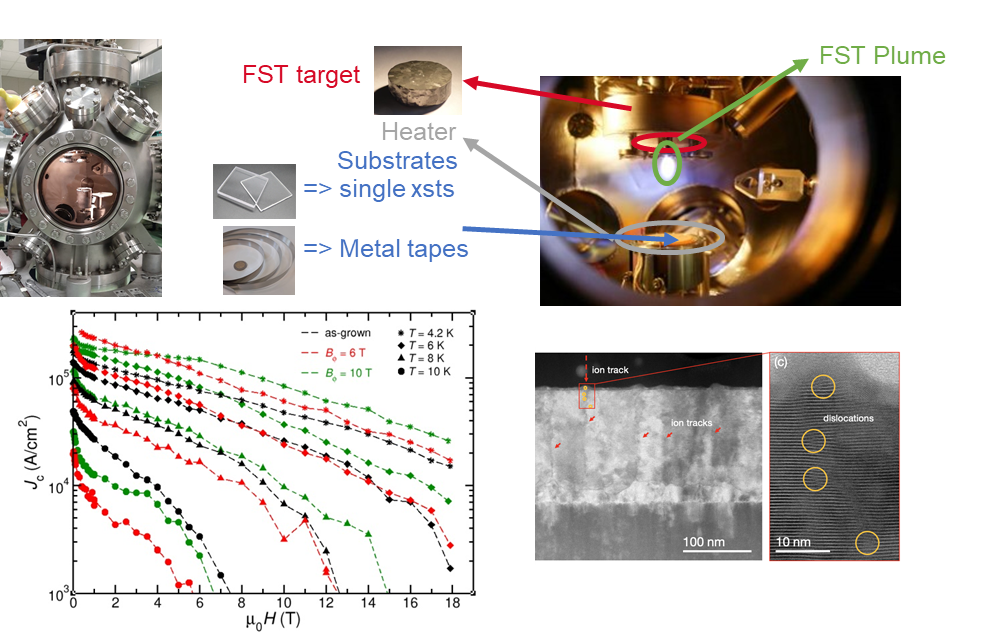
We irradiated FeSeTe with heavy ions (Au and Pb) and fluences corresponding to equivalent fields of 6T and 10 T, and showed that irradiation introduces vertical dislocations or columnar defects resulting in an increase in Jc between 6 and10 T.