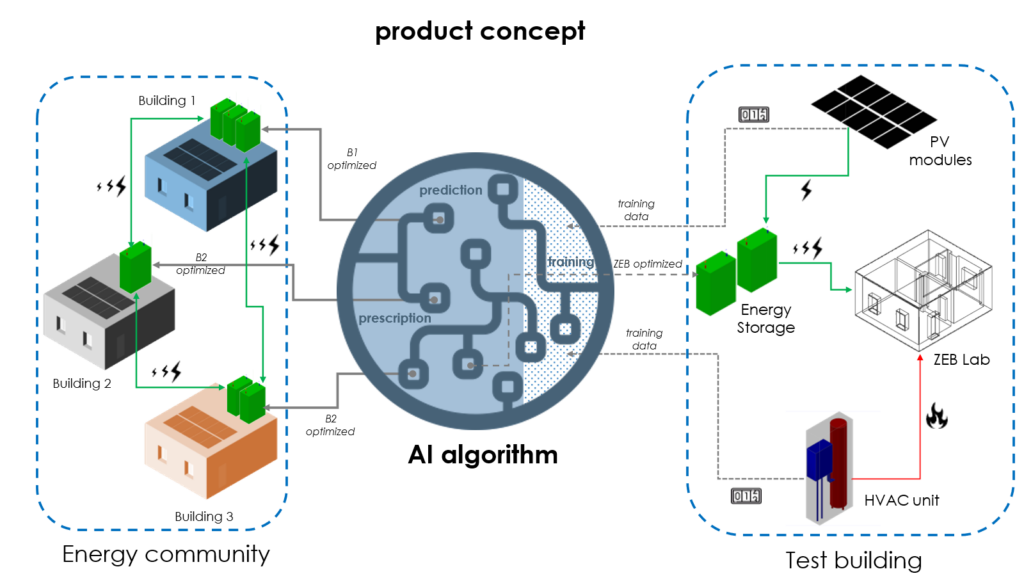
 Product 8.4
 AI-based solution for performance optimization of lithium storage systems in Zero Energy Buildings
The objective of this project is the development of solutions for the optimal management of energy storage systems using predictive and prescriptive analytics techniques. This work was coordinated by the CNR (IMATI and ITC) and the University of Genoa (DITEN Department), with the participation of the engineering and consultancy company IESolutions as a project partner.
The main activities include
- Adaptation of descriptive power system analytics and diagnostic tools for the monitoring and management of lithium storage systems.
- Analysis, development, and implementation of predictive analytics techniques for modeling storage round‑trip efficiency and estimating the state of charge based on experimental data, development, and implementation of predictive analytics techniques for the modeling of storage round-trip efficiency and estimation of state of charge through experimental data.
- Definition and experimental validation of prescriptive analytics techniques (e.g., optimization and Model Predictive Control) for the optimal management of storage systems—both stand‑alone and integrated within microgrids or energy communities and coupled with renewable plants or fuel cells—with the possibility of participating in different markets (e.g., day‑ahead, intraday, and ancillary services).
The algorithms are deployed and tested in the Zero Energy Building (ZEB) laboratory of ITC‑CNR in San Giuliano Milanese. The laboratory is equipped with an HVAC system, consisting of a hydronic heat pump and a heat‑recovery mechanical ventilation system, photovoltaic modules, and a lithium battery (2.5 kW/5 kWh).
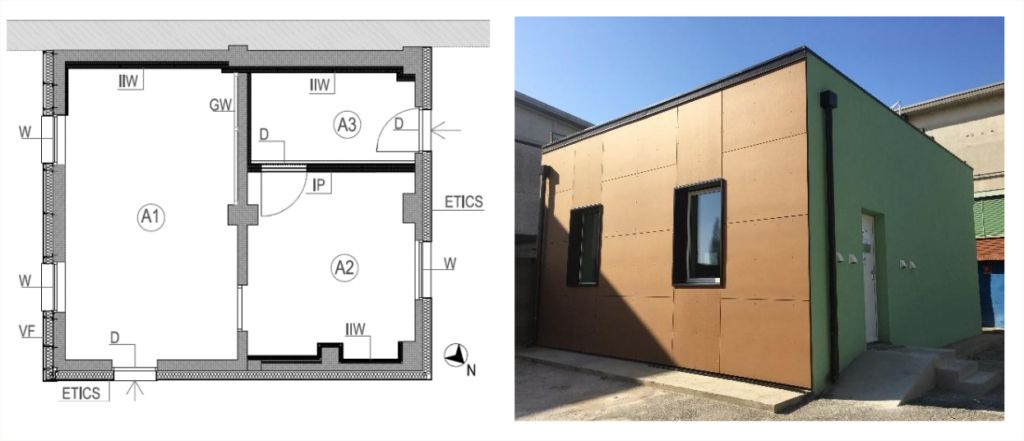
The ZEB laboratory, located at the ITC‑CNR headquarters in San Giuliano Milanese, is a single‑floor structure designed to simulate an office building. During the project, the laboratory was retrofitted with the installation of a new HVAC system, a new inverter and lithium battery, a dedicated monitoring system, and a Building Management System (BMS).
The HVAC system consists of a full‑inverter monoblock air‑to‑water heat pump for heating, cooling, and domestic hot water production. It operates with outdoor temperatures down to −20 °C and produces hot water up to 65 °C. The refrigerant and hydraulic circuits are fully monitored to calculate thermodynamic properties, thermal power exchanged within cycle components, and performance indicators under different operating conditions and configurations. This data are also used to validate the thermal model of the system.
The BMS integrates both existing devices and newly developed tools.
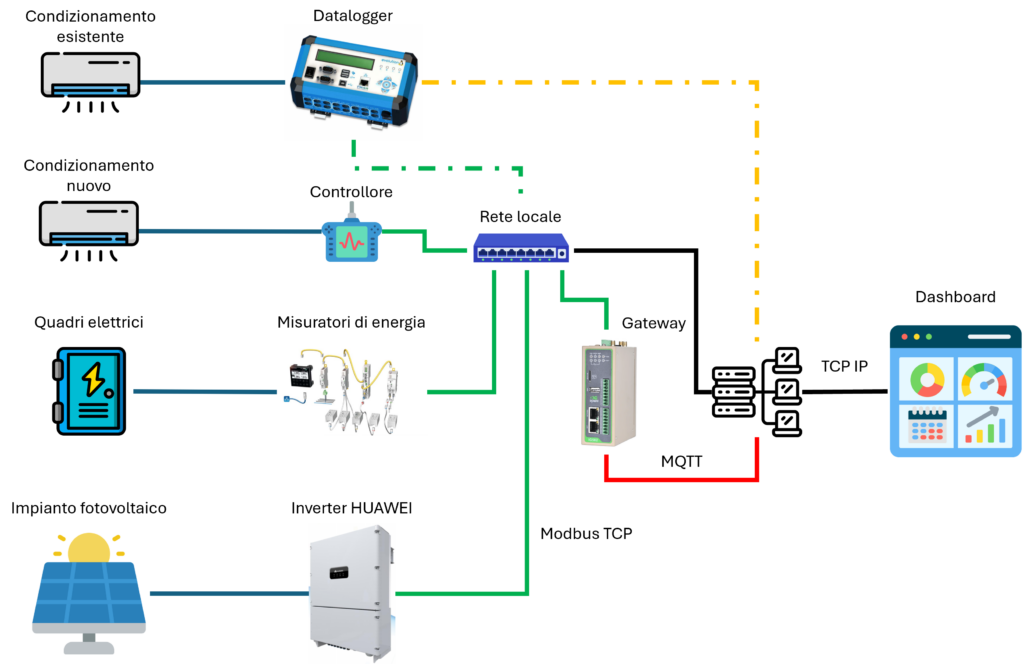
The gateway transmits collected data via the MQTT protocol to a central system installed on a local server. All elements of the architecture share the same TCP network, enabling correct and reliable communication. The platform allows data visualization through dedicated dashboards, designed according to the system architecture.
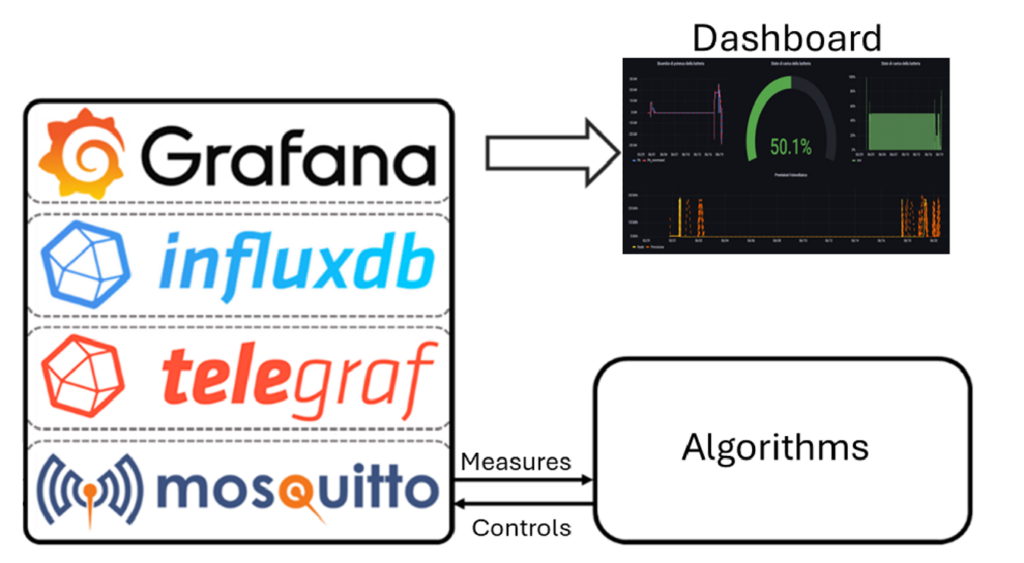
The BMS determines the operating parameters of the system—including PV panels, batteries, and the heat pump—in order to maintain indoor comfort while minimizing energy consumption. These decisions are based on forecasts of electrical load and PV production over a defined time horizon.
The monitoring system enables the development of a data‑driven framework that learns from measured data to forecast electrical loads. PV production is estimated either through a clear‑sky model or a neural network, depending on cloud cover. The base electrical load is forecast using a neural network trained on ZEB data, including calendar information and historical load values.
Since the heat pump represents the most significant source of electrical consumption, a dedicated physics‑based thermodynamic model of the building has been developed to represent the thermal load. The model is based on a resistance‑capacitance (RC) electrical analogy and supports the control system’s decision‑making process.Within the RC framework, each wall (including floors and ceilings) is modeled using a 3R2C approach. The three resistances represent the internal surface resistance, external surface resistance, and equivalent resistance. The internal and external thermal capacities (Ci and Ce) are obtained through regression analysis based on internal and external surface temperature trends calculated using a finite‑difference method.
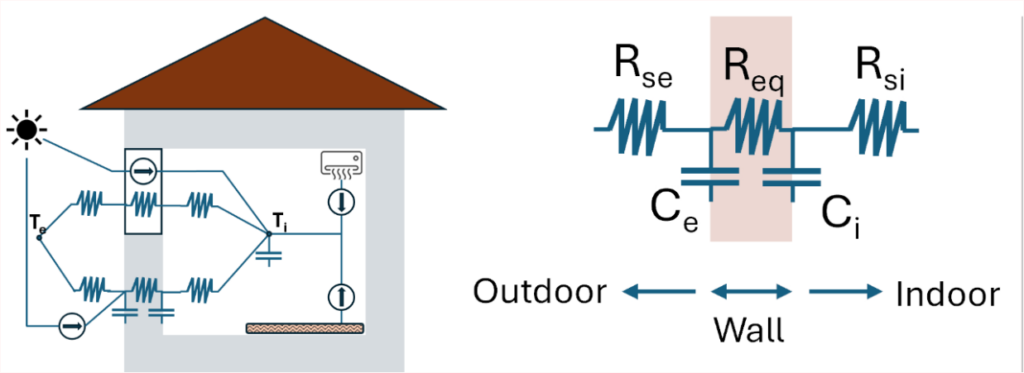
In addition, the model accounts for indoor humidity through a dedicated vapor balance that considers vapor content in the zone, external air, and internal latent gains.
The model was developed using custom code written in Python and is therefore open‑source. For integration into the AI‑based control algorithm, the RC model is simplified and linearized rather than solved iteratively.
The objective of the BMS is to optimize controllable resources, specifically the active power set‑points of the storage system and the temperature set‑points of the HVAC system.
Model Predictive Control (MPC), based on a Mixed‑Integer Linear Programming (MILP) formulation, is implemented to minimize energy purchasing costs and, where possible, maximize revenues from energy sales. In addition, the MPC can be configured to maximize the incentives related to energy communities and self-consumption. The proposed approach uses forecasts of electrical load and PV production and incorporates users’ thermal comfort through a simplified thermal model driven by weather forecasts and real‑time measurements.
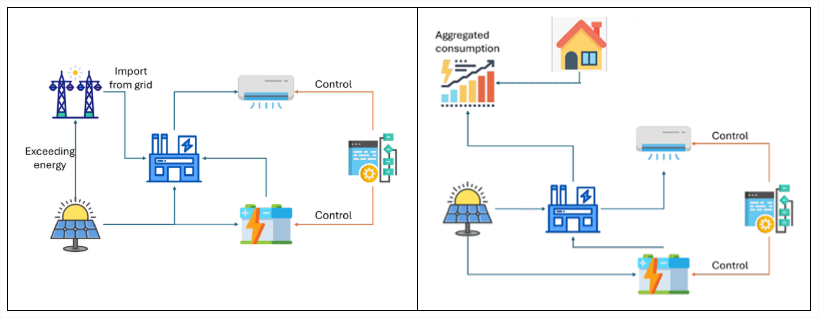
Examples of operational scenarios used to validate the BMS are illustrated in the next figure. Tests have indicated potential for economic benefits also in more complex scenarios.