
 Product 5.1
 An integrated monitoring system for precision agriculture and land management
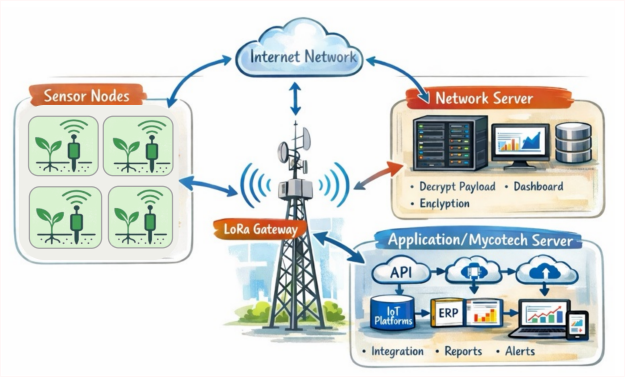
Within the framework of the RAISE Project – Spoke 3, Project 5 (“Advanced technologies and robotic solutions for precision agriculture and for reforestation”), an advanced environmental monitoring system has been designed, implemented, and validated as a pilot demonstrator for precision viticulture. The initiative aims to foster sustainable, data-driven agricultural practices by integrating low-power sensing technologies, long-range wireless communication, and scalable digital infrastructures. The primary goal of the system is to support farmers and technical operators in making informed decisions that optimize crop management while reducing environmental impact. Modern agriculture increasingly requires precise monitoring of environmental and soil conditions in order to maximize productivity, improve resource efficiency, and minimize the use of water, fertilizers, and chemical treatments. The developed solution directly addresses these needs by providing continuous, remotely accessible measurements of key agro-meteorological and soil parameters. The implemented architecture is based on a modular Internet of Things (IoT) approach leveraging LoRaWAN technology. The system consists of five main components: distributed sensor nodes installed in the field, a LoRaWAN gateway, a network server, an application server, and a data visualization and access platform (Mycotech Server). This layered architecture (see Figure 1) ensures scalability, flexibility, and full control over both hardware and software elements.
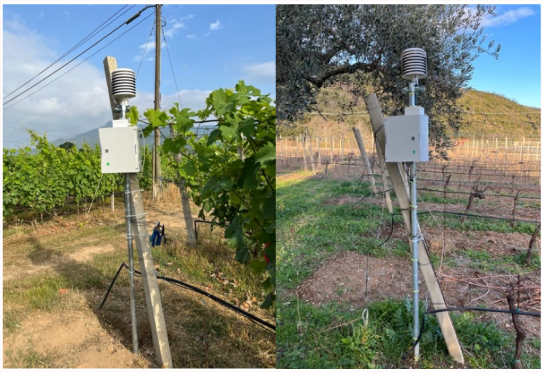
Six wireless sensor nodes (see Figure 2) were deployed in a vineyard located in Ortovero (Savona, Italy), selected as the pilot test site. These nodes were specifically engineered for long-term outdoor operation and low energy consumption. Each unit is housed in a robust fiberglass enclosure and powered by an internal battery capable of guaranteeing several months of autonomous operation. The hardware design includes a LoRaWAN system-on-chip with an ARM Cortex-M0+ core and a Semtech SX1262 transceiver operating in the 868 MHz ISM band, fully compliant with European regulations. The nodes integrate multiple transducers capable of measuring air temperature and humidity, solar radiation, soil moisture, soil temperature, soil electrical conductivity, and the concentration of macronutrients such as nitrogen (N), phosphorus (P), and potassium (K). This comprehensive set of measurements provides a detailed picture of both atmospheric conditions and soil status, enabling fine-grained agronomic assessment.
Data transmission is handled through a LoRaWAN communication infrastructure. The gateway, installed in proximity to the vineyard and equipped with a collinear antenna and mini-UPS backup system, collects radio packets from the nodes and forwards them to the back-end servers via an Internet connection. Security and data integrity are ensured through AES-128 encryption at the LoRaWAN level and through a dedicated encrypted VPN tunnel between the gateway and the central infrastructure. This configuration guarantees confidentiality, secure authentication, and the possibility of remote device management and reconfiguration.
The back-end infrastructure is built entirely on open-source technologies to ensure transparency, adaptability, and long-term sustainability. The ChirpStack platform (version 4) implements the LoRaWAN network stack and manages device authentication, message routing, and downlink communication. Telegraf is used to subscribe to MQTT topics and process incoming data streams, which are then stored RAISE SPOKE 3 5/6 SUMMARY of Product 5.1 in an InfluxDB2 time-series database. Grafana provides powerful visualization capabilities through interactive dashboards and customizable time-series charts. An Apache web server publishes the processed information via a dedicated web portal, enabling authorized users to explore collected data through intuitive graphical interfaces.
A key feature of the system is its strong emphasis on usability and accessibility. In addition to the web- based dashboards (see Figure 3a), a Telegram bot named WineTechBot has been developed to facilitate real-time data consultation directly from smartphones and mobile devices (see Figure 3b). This solution leverages the widespread adoption of messaging applications to simplify remote monitoring, making the platform accessible not only to technical personnel but also to farmers and field operators with minimal technical background. The dual-access strategy—web portal and mobile bot—enhances the practical adoption potential of the system.
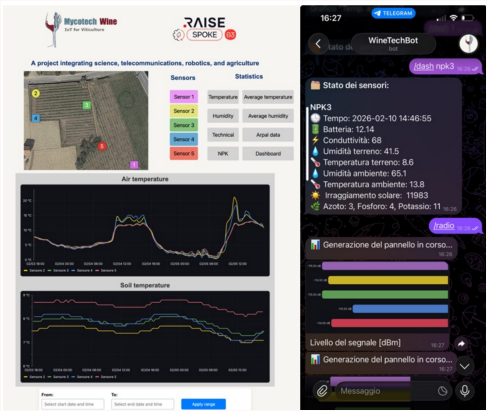
application illustrating data collected from the vineyard
Preliminary operational tests carried out in the vineyard confirmed the robustness and reliability of the entire infrastructure. The sensor nodes demonstrated stable performance under real environmental conditions, maintaining consistent data acquisition and transmission over extended periods. Battery autonomy met or exceeded the design expectations, and the communication chain—from node to gateway to server—operated without significant disruptions. The collected datasets revealed measurable spatial variability in soil parameters, confirming the sensitivity of the system to microclimatic and soil RAISE SPOKE 3 6/6 SUMMARY of Product 5.1 differences across the monitored area. Such variability is critical for precision agriculture applications, as it supports site-specific interventions and optimized resource allocation. The pilot implementation has therefore demonstrated not only the technical feasibility of the proposed architecture but also its practical value in real agricultural contexts. The system provides continuous, accurate, and remotely accessible environmental measurements that can support irrigation scheduling, fertilization strategies, nutrient management, and overall vineyard planning. Moreover, the modular and scalable design of the platform establishes a solid technological foundation for future developments, including the integration of machine learning algorithms, predictive analytics, and automated decision- support tools.
In conclusion, the developed monitoring system represents a concrete and operational outcome of the RAISE initiative. It goes beyond a conceptual prototype by delivering a fully deployed, field-tested digital infrastructure capable of supporting sustainable agricultural practices. Finally, it is worth noting that the data measured and collected through this monitoring infrastructure were not only used for validation purposes but also actively employed in the execution of Product 5.2.