
 Product 1.9
 Label-free polymer photonic sensors
The activity focuses on developing polymer and hybrid polymer-inorganic photonic structures (made of virgin, recycled and bioderived/biodegradable materials) for the detection of chemical pollutants in water and air.
The results of Prodcut 1.9 are divided into the following categories:
- Papers
- Invited Seminars
- Conferences (invited)
- Science Popularization Events (in Italian)
- Master Thesis
The most relevant activity within RAISE – concerning pollutant sensing in water – is not reported here as currently under analysis for publication/patenting.
1) Papers
1.a) L. Magnasco, A. Lanfranchi, M. Martusciello, H. Megahd, G. Manfredi, P. Lova, B. Koszarna, D.T. Gryko, D. Comoretto*
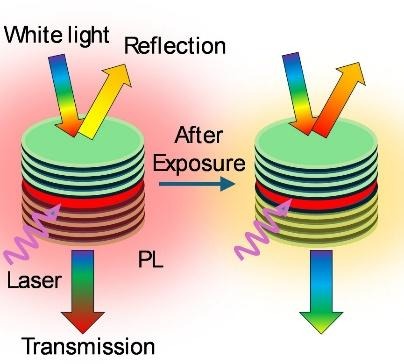
FLUORIMETRIC DETECTION OF VAPOR POLLUTANTS WITH DIKETOPYRROLOPYRROLE POLYMER MICROCAVITIES, ACS Omega 2024, 9, 42375–42385, https://doi.org/10.1021/acsomega.4c05710
Description:
The research activity consisted in developing a sensor for pollutants (dichloromethane, ethanol, 1-butanol in the gas phase based on a microcavity fully polymeric optical cavity doped with semiconductor crystals. Compared to previous works, the innovation consisted in using a double detection simultaneously with both transmittance and fluorescence measurements. This activity was fully developed at the Department of Chemistry and Industrial Chemistry of the University of Genoa in the framework of the RAISE project.
1.b) E. Benvenuti, A. Lanfranchi, S. Moschetto, M. Natali, M. Angelini, P. Lova, F. Prescimone, V. Ragona, D. Comoretto, M. Prosa, M. Bolognesi and S. Toffanin
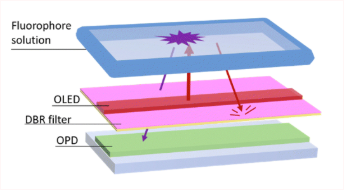
ON-CHIP ORGANIC OPTOELECTRONIC SYSTEM FOR FLUORESCENCE DETECTION, J. Mater. Chem. C 12, 4243-4252 (2024), https://doi.org/10.1039/D3TC04321E
Description:
Integrated organic microfluidic sensors for fluorescence detection have been developed based on the combination of Organic Light Emitting Diode (OLED) light sources and Organic PhotoDetectors (OPD) detectors. As part of the research activity developed by the CNR research group of Bologna in the development of optoelectronic sensors, the research unit of the Department of Chemistry and Industrial Chemistry of the University of Genoa has collaborated by exploiting its expertise in photonics by realizing the polymeric filters (Distributed Bragg Reflectors, DBR) used in the fluorescence signal detection chain
2) Invited Seminars
2.a) D. Comoretto – POLYMER PHOTONIC CRYSTALS MULTILAYERED STRUCTURES: SENSING, MECHANOCHROMISM, THERMAL MANAGEMENT AND MORE, Research Center for Materials Nanoarchitectonics (MANA), National Institute for Materials Science, Tsukuba – Japan, September 29th, 2025.
2.b) D. Comoretto – POLYMER PHOTONIC CRYSTALS MULTILAYERED STRUCTURES: SENSING, MECHANOCHROMISM, THERMAL MANAGEMENT AND SUSTAINABILITY, Nanyang Technological University – Singapore, SCHOOL OF PHYSICAL AND MATHEMATICAL SCIENCES DIVISION OF PHYSICS AND APPLIED PHYSICS, September 19th, 2025.
3) Conferences (invited)
D. Comoretto – POLYMER ARCHITECTURES FOR SUSTAINABLE PHOTONICS, 15th Conference on Advanced Polymers via Macromolecular Engineering (APME), 4 – 8 May 2025, Aci Castello, Catania – Italy
4) Science Popularization Events (in italian)
4.a) D. Comoretto – Farfalle Fotoniche! Dal colore strutturale alla fotonica passando per le sociocromie, S.A.R.O’ (Settimana realmente orientativa), Liceo Da Vigo-Nicoloso da Recco, Recco (Ge), 27 Novembre 2025.
4.b) D. Comoretto – Farfalle Fotoniche!, UniGeSenior – I corsi liberi per tutte le età, 06 Febbraio 2025.
4.c) D. Comoretto – Farfalle Fotoniche! (dal colore strutturale alla fotonica, passando per le sociocromie), IANUA – Scuola Superiore dell’Università di Genova, https://ianua.unige.it/seminario-ianua-farfalle-fotoniche, 23 Aprile 2024
5) Master Thesis
CORSO DI LAUREA MAGISTRALE IN CHIMICA INDUSTRIALE, Dipartimento di Chimica e Chimica Industriale – UniGE, ANNO ACCADEMICO 2023/2024
Title: STIMULI RESPONSIVE OPTICAL NANOSTRUCTURE
Student: Alessandro Manca
Supervisors: Prof. Davide Comoretto; Prof. Albert Schenning (Technical University Eindhoven, NL)
Co-Supervisors: Prof. Paola Lova, Prof. Alberto Servida
Summary: The growing impact of marine pollution, particularly from common organic solvents (OS), such as chlorobenzene, chloroform, dichloromethane, toluene and others petroleum-derived products, has emerged as a critical challenge to both environmental sustainability and public health. These pollutants originate from various anthropogenic activities, including industrial effluents, improper waste disposal, urban runoff, and accidental spills. Rivers often act as transport pathways for these pollutants, carrying OS-containing runoff from inland industrial areas and agricultural operations into coastal and marine ecosystems. In marine environments, additional sources of OSs contamination include fuel leaks and spills from boats and ships, accidents during refueling, and maintenance activities involving these pollutants. Such inputs lead to the pervasive dispersion of OSs in aquatic systems, significantly contributing to environmental degradation. OSs interfere with the physiological and reproductive systems of marine organisms, especially during sensitive embryonic and larval stages, and threaten biodiversity by endangering vulnerable species. Their persistence in aquatic environments facilitates bio accumulation in food webs, posing serious risks to human health.
In this context, the development of efficient, reliable, and cost-effective methods for detecting OSs in seawater is imperative. Among emerging solutions, photonic crystals (PhCs) such as Flory-Huggins polymers (FHPs)-based distributed Bragg reflectors (DBRs), represent a promising method. These materials combine low fabrication costs with strong spectral responses, enabling easy and precise optical detection of pollutants. By leveraging the optical properties of DBRs, this research aims to establish an innovative platform for monitoring OSs contamination in seawater.
Part of the thesis – concerning temperature liquid crystal sensors – has been developed during a stay at the Technical University Eindhoven (NL).